💼 How Medical Dictation Software Helps Prevent Claim Denials
If you haven’t yet read the first part of this series — 🩺 Why Every Doctor Should Be Using Medical Dictation Software — start there to see how voice technology improves documentation accuracy and revenue capture. This article continues that conversation, focusing on how medical dictation software helps prevent claim denials and strengthens financial confidence.
🧾 The Hidden Cost of Claim Denials
Every provider knows the frustration of a denied claim. After taking care of patients, dictating notes, and preparing documentation, having a claim rejected feels like a personal and financial loss.
According to the American Medical Association, up to 9% of medical claims are initially denied, and it costs practices $25 to $118 to rework each one. For small clinics, those numbers quickly compound into thousands of dollars in lost income every month.
The main causes are usually:
- Missing or incorrect CPT or ICD-10 codes
- Incomplete documentation or insufficient detail
- Misalignment between procedures and diagnoses
- Ambiguous or inconsistent physician notes
Most of these issues originate in the documentation process — and that’s exactly where medical dictation software can make the biggest impact.
🧠 How Dictation Software Reduces Errors at the Source
Unlike old-style transcription systems, today’s medical dictation tools use AI-based speech recognition trained on medical language, abbreviations, and procedure codes. They don’t just convert speech to text — they interpret context.
For example:
“Performed joint aspiration and injected corticosteroid under sterile technique.”
A simple transcription might stop there. But AI-enhanced dictation recognizes the procedure and can associate it with CPT 20610 (arthrocentesis, aspiration, and/or injection, major joint).
That connection — made automatically during documentation — ensures your billing staff doesn’t miss a charge later.
This direct link between spoken notes and CPT accuracy is one of the most powerful defenses against denied or under-coded claims.
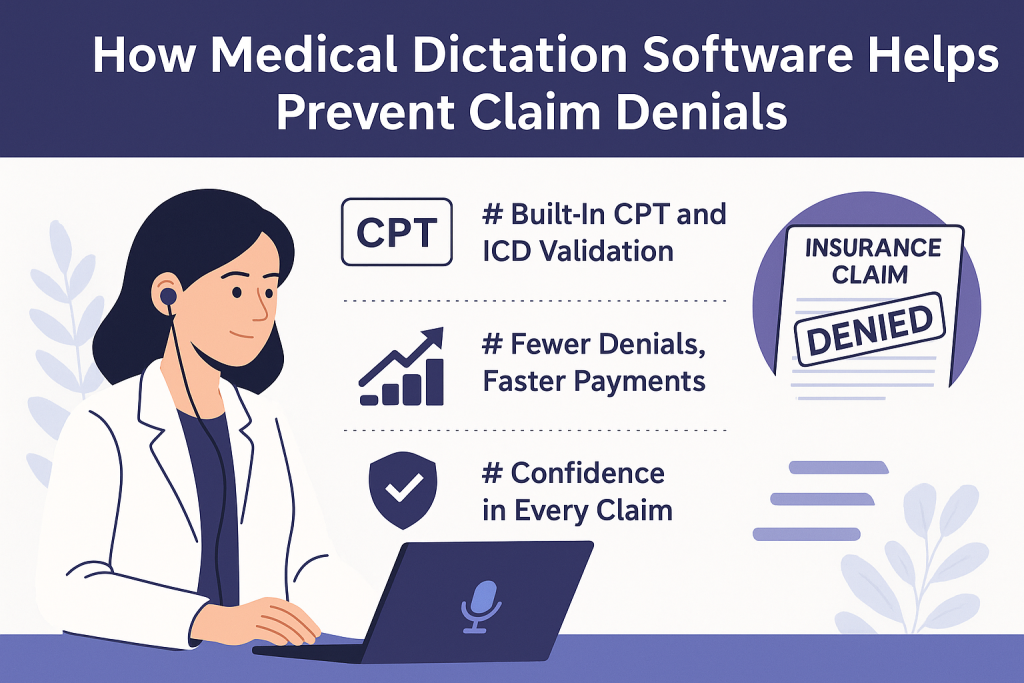
🔍 Built-In CPT and ICD Validation
Many modern tools include real-time code validation. As you dictate, the software cross-checks your language against coding databases to flag potential gaps or inconsistencies.
For instance:
- If you mention “follow-up for diabetes management” but omit an E11.x diagnosis, the software highlights it immediately.
- If your note suggests a Level-4 E/M visit but the supporting complexity isn’t documented, the system prompts you to clarify before finalizing.
These real-time alerts prevent under-documentation and help ensure that claims meet payer requirements the first time around.
💰 Fewer Denials, Faster Payments, Stronger Revenue
Accurate dictation directly translates to financial performance.
When your notes are complete and consistent:
- Denials drop — because coders no longer have to guess what was done.
- Reimbursement increases — since every billable service is captured correctly.
- Payment cycles shorten — with fewer re-submissions and clarifications needed.
Practices using AI-based dictation tools typically see 10–20% higher first-pass acceptance rates and 30% fewer claim rejections, leading to thousands of dollars in recovered revenue each quarter.
🩺 Real-World Example
A multi-specialty clinic in North Carolina implemented AI-powered dictation integrated into its EHR.
Before adoption, their average claim denial rate was 11%. Six months later, denials fell to under 4%.
The result? Roughly $7,000 per month in recovered revenue — not from adding patients or services, but simply by improving documentation accuracy through dictation.
🧩 Tools That Help Prevent Claim Denials
Here are three leading platforms that combine medical speech recognition with coding intelligence.
1. DeepScribe
DeepScribe listens to patient encounters and generates structured clinical notes automatically.
- Recognizes procedures and associates them with correct CPT/ICD codes
- Integrates directly with major EHRs like Epic and Athenahealth
- Provides AI prompts for missing or ambiguous details
Perfect for outpatient practices and telehealth providers who need hands-free documentation and coding support.
2. Suki AI
Suki acts as a voice assistant that creates notes, adds billing codes, and organizes data hands-free.
You can simply say:
“Suki, add CPT 99214 for a 25-minute visit with moderate complexity.”
- Smart CPT/ICD tagging built-in
- HIPAA-compliant and cloud-based
- Works across desktop and mobile
Suki dramatically reduces missed codes and ensures every claim is backed by a complete note.
3. Dragon Medical One
The industry standard in medical dictation, Dragon offers enterprise-grade accuracy and deep EHR integration.
- Context-aware speech recognition
- Specialty-specific templates and macros
- Streamlined workflows for faster documentation
Hospitals and group practices rely on Dragon to keep billing aligned with actual patient encounters — minimizing compliance risks and improving coding precision.
🧾 From Dictation to Denial Prevention
Here’s how these systems fit into your workflow:
- Dictate immediately after the visit.
- The AI converts speech into structured, coded notes.
- The system flags missing data before sign-off.
- Billing staff review and submit clean claims with confidence.
By closing that documentation gap early, your team spends less time correcting rejections and more time improving patient care.
🔒 Confidence in Every Claim
Perhaps the biggest benefit isn’t just financial — it’s psychological.
With structured, validated notes, you know that each claim you submit is backed by complete clinical justification.
That reduces stress, compliance risk, and post-submission workload.
Doctors who switch to dictation often report:
- Less time correcting EHR entries
- More accurate charting
- A renewed sense of control over billing and reimbursement
🚀 The Bottom Line
In today’s healthcare landscape, precision equals protection.
Medical dictation software gives you that protection — transforming the way you document, bill, and defend your claims.
By combining AI-driven transcription with CPT validation and context awareness, these tools don’t just save time — they prevent denials before they happen and ensure every service is properly reimbursed.
If your goal is to work smarter, reduce administrative frustration, and safeguard revenue, investing in a modern dictation solution is one of the most impactful decisions your practice can make.