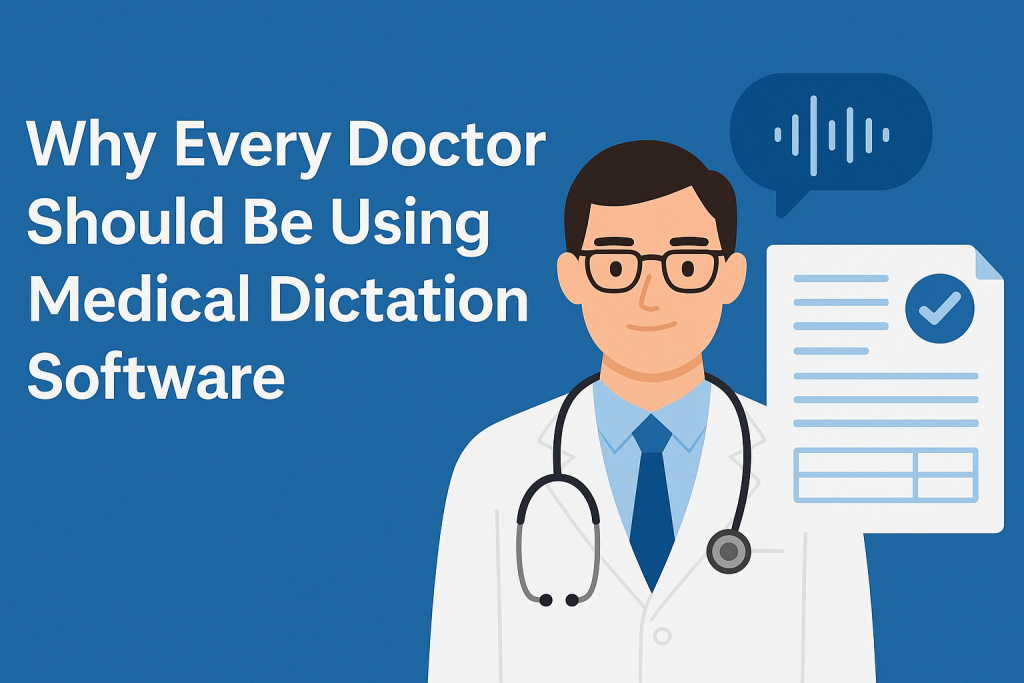
🩺 Why Every Doctor Should Be Using Medical Dictation Software
In today’s fast-moving healthcare environment, accuracy and time are everything. Between patient visits, EHR updates, and insurance documentation, even the most organized physicians can miss critical details. One small omission — like a forgotten CPT code or incomplete note — can delay or even deny reimbursement.
That’s where medical dictation software changes the game. It’s no longer just a convenience; it’s a strategic tool that directly improves revenue, compliance, and confidence when submitting claims.
🗣️ From Paperwork to Precision
Doctors are trained to focus on patient care — not typing endless notes. Yet administrative work can consume hours daily. Medical dictation software lets physicians speak naturally while it automatically transcribes and structures the documentation in real time.
Modern tools go beyond simple speech-to-text. They understand medical terminology, abbreviations, and contextual cues — ensuring that procedures, diagnoses, and CPT codes are accurately reflected.
This means fewer missed charges, cleaner documentation, and more complete claims.
💡 How Dictation Software Helps Prevent Missed CPT Codes
Missing CPT (Current Procedural Terminology) codes is one of the most common causes of lost revenue in medical practices. Sometimes, it happens because:
- A physician forgets to document a secondary procedure.
- Notes are too brief or lack detail for coding staff to assign the correct code.
- Time constraints lead to incomplete dictation before the claim submission deadline.
Medical dictation software helps eliminate those risks by capturing every detail in real time — directly from the physician’s voice. Many advanced tools even include AI-assisted code suggestions or integrate with EHR systems to flag missing or inconsistent codes.
As a result, before a claim is submitted, the system can prompt:
“Did you mean to include CPT 99214 for this extended visit?”
That single reminder can mean hundreds or thousands of dollars recovered every month.
💰 More Accuracy, More Revenue
When dictation software ensures that documentation is complete and codes are properly captured, your claims get processed faster and paid sooner. Denials go down, resubmissions drop, and your billing staff can focus on growth rather than corrections.
According to industry studies, clinics using AI-driven dictation tools see:
- Up to 30% fewer claim denials
- An average 12–20% increase in captured revenue
- Significant reductions in provider burnout
Each accurately transcribed note becomes a revenue opportunity that might have otherwise been lost in the shuffle of manual documentation.
🔍 Confidence in Claim Submission
Submitting a claim with confidence is more than just good administration — it’s financial protection. When every diagnosis and procedure is captured in context, you can stand behind every claim you file.
Dictation software creates structured documentation trails that clearly link medical necessity to procedures performed. That makes audits smoother and denials easier to appeal, should they occur.
In short: medical dictation gives you the data integrity and traceability that manual entry rarely achieves.
⚙️ Tools That Can Help You Get There
Here are three excellent medical dictation solutions designed to improve accuracy, documentation, and billing outcomes:
1. Dragon Medical One
The gold standard in medical speech recognition. Dragon Medical One offers cloud-based dictation that integrates directly with leading EHR systems.
- Recognizes complex medical terms instantly
- HIPAA-compliant and secure
- Customizable templates and macros for faster charting
- Used by hospitals and private practices worldwide
Its real-time voice understanding ensures all procedures are captured, reducing missed CPT codes.
2. DeepScribe
DeepScribe takes a conversational approach. It listens during patient encounters and automatically creates AI-generated medical notes, complete with suggested diagnoses and billing codes.
- Automatically detects CPT and ICD-10 relevance
- Integrates with EHRs like Epic and Athenahealth
- Reduces note-taking time by up to 75%
DeepScribe helps doctors reclaim valuable time while boosting billing accuracy — ideal for outpatient or telemedicine settings.
3. Suki AI
Suki is an AI-powered voice assistant for doctors. You can say “Hey Suki, create a note for patient John Smith,” and it will pull up relevant data, transcribe your dictation, and even suggest billing codes.
- Context-aware voice recognition
- CPT and ICD support built in
- Works on mobile, web, or EHR environments
It’s designed to help physicians document faster and ensure no revenue-impacting details are overlooked.
🧠 Smarter Workflow, Healthier Practice
Imagine finishing your last appointment of the day and realizing your notes are already complete — every detail, every code, every follow-up included. No late nights typing. No guessing which level of visit you billed. Just accurate, revenue-ready documentation.
That’s the reality for physicians who embrace modern dictation tools. The benefits go far beyond convenience:
- Cleaner claims → fewer denials
- More accurate coding → higher reimbursement
- Better audit trail → greater peace of mind
And with AI-driven transcription improving rapidly, dictation accuracy now rivals — and often exceeds — human transcription.
🚀 The Future of Medical Documentation
The future of healthcare documentation is voice-driven, intelligent, and integrated. Dictation software is no longer a luxury; it’s an essential revenue-preservation tool.
Doctors who adopt it not only save time but also protect their income — ensuring every service rendered is captured, coded, and reimbursed properly.
So if you’re still relying on manual entry or generic speech-to-text apps, it might be time to upgrade.
Because in modern medicine, dictation isn’t just about speed — it’s about accuracy, compliance, and financial confidence.